
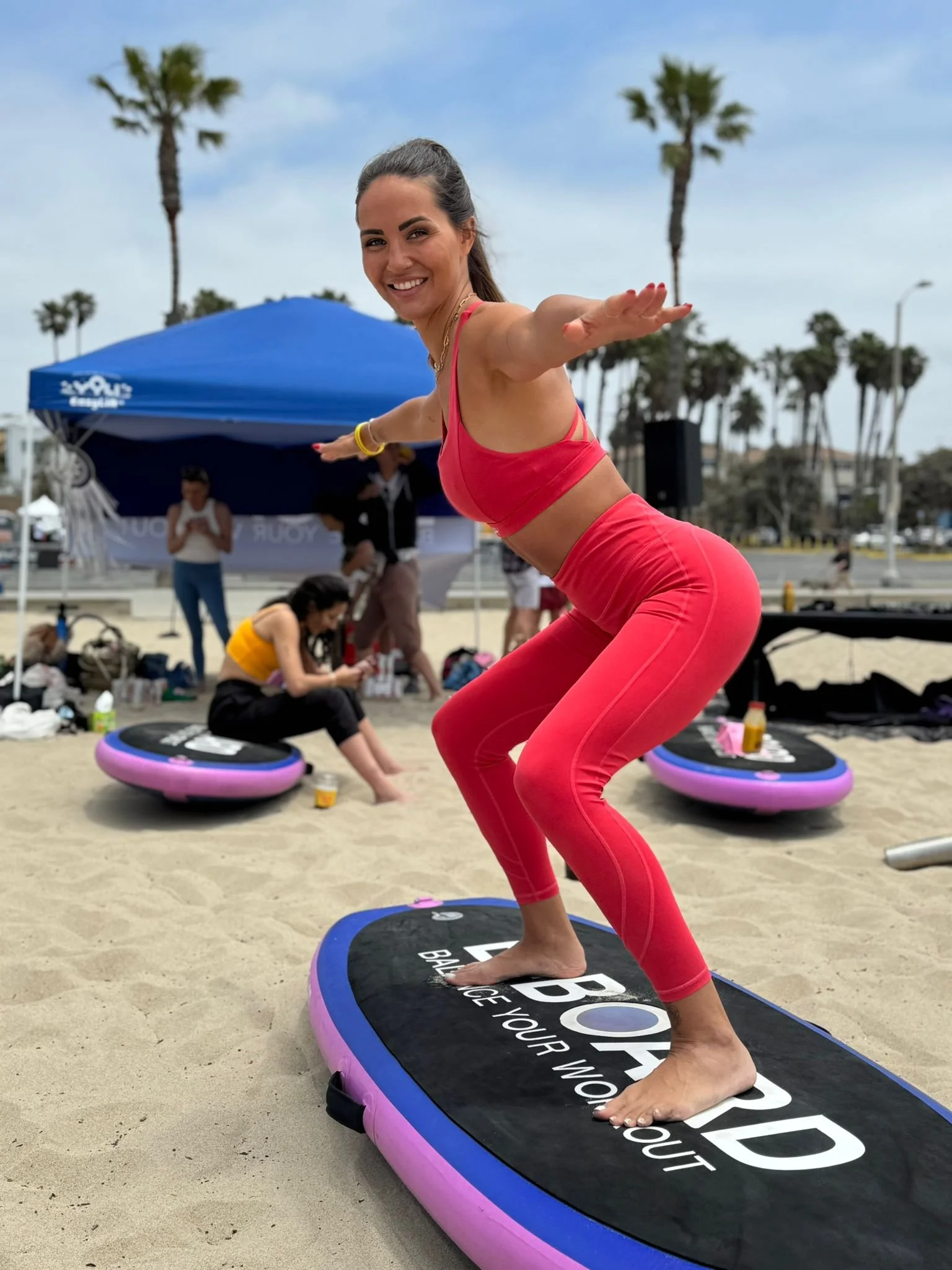
Can you bring the balance challenge of paddleboarding onto land? Yes. An inflatable balance board such as B-BOARD® lets you explore paddleboard-inspired movement at home, in a studio or during a fitness class. Its rounded inflatable base moves beneath you, adding a balance challenge to exercises such as squats, planks and yoga poses.
That changing surface is what makes the experience interesting. As you shift your weight, you need to adjust your position and control the movement beneath you. A familiar exercise becomes an opportunity to practise balance, coordination and core control.
What does paddleboarding on land mean?
In a fitness setting, paddleboarding on land means using equipment that recreates aspects of the balance experience of stand-up paddleboarding, also called SUP.
On a floating board, your body responds to both your movements and the water. On B-BOARD®, the inflatable base introduces movement underneath the platform while you exercise on land. You can explore standing positions, weight transfers and changes of direction in a home or fitness environment.
The focus here is balance-based exercise. Paddling technique, steering and responding to water conditions remain skills to practise on the water. Land training offers another environment in which to work on movement and body control.
How does B-BOARD® create the experience?
B-BOARD® is an inflatable fitness platform from LEVEL FITNESS, designed for balance training, functional exercises, yoga and Pilates. Its long, mat-like platform provides room for standing, kneeling and supported floor-style movements.
With its rounded base against the floor, the platform responds as your weight moves. During a squat, for example, you need to manage the movement of your hips and knees while keeping your position on the board.
You can also adjust the inflation of the bottom chamber within the manufacturer's setup guidance to change how the board responds. Begin with a setup you can control and develop confidence before introducing more demanding movements.
Getting started with a land-based balance workout
Set up your board according to its instructions on a clean, level surface where it will not slip. Leave clear space around it for stepping on, stepping off and moving your arms and legs.
Start near a stable support you can reach without leaning or twisting. Warm up on the floor, then take time to become comfortable getting onto the board. Keep your eyes open, breathe naturally and choose a small range of movement initially.
If a movement feels difficult to control, practise it on the floor first or ask an instructor to help you adapt it. You can also flip the board over and practice on the round part for an easier introduction.
Five B-BOARD® exercises to explore
1. Standing balance hold
With support available, position your feet comfortably apart on the board. Soften your knees and look at a fixed point ahead. Allow small adjustments through your ankles, knees and hips as you settle into your stance.
Begin with a brief hold, then step off with control. Increase the time gradually as the position becomes more familiar.
2. Gentle weight shifts
From your standing position, move a small amount of weight toward one foot, then return to the middle. Repeat toward the other foot. Keep both feet in contact with the board and make each transfer slow and deliberate.
Start with a few shifts each way. Use a smaller movement or hold a stable support if needed.
3. Shallow squat
Once standing feels comfortable, bend your hips and knees into a shallow squat. Keep your knees following the direction of your toes and maintain contact through both feet. Press back up to your starting position without rushing.
Try a few repetitions with a modest range of motion. Develop control before adding depth, speed or resistance.
4. Bird dog progression
Begin on your hands and knees on the board. First, try sliding one hand forward while keeping the other three points of support in place. Return and change sides. As your control develops, explore extending one leg, then an opposite arm and leg together.
Keep your trunk steady and your movements small. Use appropriate knee padding for comfort.
5. Supported forearm plank
Perform the entire plank on B-BOARD®. Place your forearms on the board with your elbows beneath your shoulders. Extend your legs behind you and rest your toes on the board. Engage your core, keep your shoulders, hips and heels aligned, and breathe naturally.
For a beginner option, lower your knees onto a bolster or padded support placed on the board, maintaining a straight line from your shoulders to your knees. Begin with short holds and build duration while maintaining control.
B-BOARD® is long enough to support the entire exercise while taking up roughly the floor space of a yoga mat, making it practical for living-room workouts.
For more movement ideas and demonstrations, explore our balance board exercise guide.
Build a short session around control
For your first sessions, choose two or three exercises that feel manageable. Perform one round, rest as needed and decide whether another round suits your energy and confidence that day.
Standing holds, gentle weight shifts and shallow squats make a simple starting sequence. Introduce kneeling and plank exercises as you become familiar with changing positions on the board.
Progress one element at a time: a longer hold, a few more repetitions or a slightly larger movement. Keep the quality of each repetition as your guide.
Where can you train?
B-BOARD® can be used in a suitable indoor space or on an appropriate outdoor surface, with enough clearance to move safely. It can also be deflated for transport and storage, making it an option for home workouts and instructors who take equipment to different venues.
The experience can be adapted for individual coaching or group sessions. For help deciding what fits your space and routine, read our guide to choosing a balance board for home workouts.
From water to land
B-BOARD® grew out of AQUA STAND UP®, our paddleboard-inspired water fitness program. Its development began with the need to demonstrate movements from the pool deck while teaching classes, bringing a balance challenge onto land.
You can read more about the story behind B-BOARD® or explore AQUA STAND UP® for the water-based experience.
Experience paddleboard-inspired training with B-BOARD®
Whether you enjoy paddleboarding or simply want to bring a different balance challenge into your routine, B-BOARD® offers a way to explore purposeful instability through familiar exercises.
Explore the B-BOARD® equipment, or discover personal training with Eric in Santa Monica, Los Angeles and Orange County for coaching adapted to your goals and experience.
